Kitchens

Cabinet Refacing vs. Refinishing vs. Replacing: Which Is Right for Your Kitchen?

By Wall to Wall Construction · Catonsville, MD · 8 min read
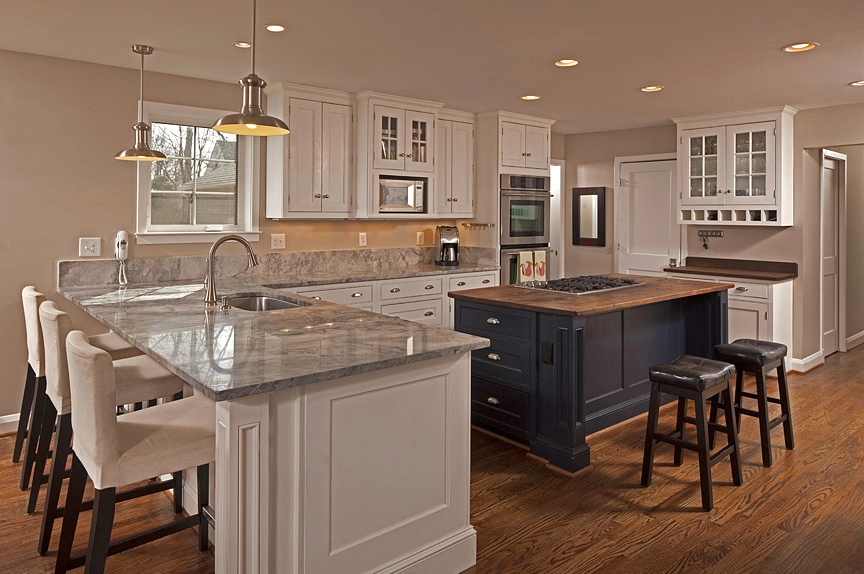
Kitchen with white painted cabinets, granite counters and a dark wood island remodeled by Wall to Wall Construction
Short answer

Refinish when the cabinet boxes and doors are solid and you only want a new color. Reface when the boxes are sound but you want new doors and a new look. Replace when the boxes are damaged or the layout no longer works. HomeGuide’s 2026 figures put refinishing at about $1,500 to $4,500, refacing at $5,000 to $13,000 and stock or semi-custom replacement at $4,500 to $15,000 for an average kitchen.

Kitchen cabinets take up more wall space than anything else in the room, so they set the look of the whole kitchen. When they start to show their age, homeowners usually weigh three paths: refinish what is there, reface it with new doors and veneer, or tear the cabinets out and start over. Each one fits a different situation, and choosing the wrong one can mean paying twice.

This guide explains what each option involves, what published cost guides say they cost, and how to tell which one your kitchen needs.

What each option means

RefinishingThe existing doors, drawer fronts and frames are cleaned, sanded and painted or stained. Nothing is replaced except, usually, the hardware.
RefacingThe cabinet boxes stay. Doors, drawer fronts and hardware are replaced, and the visible frames are covered with new veneer or laminate.
ReplacingOld cabinets come out and new ones go in. This is the only option that changes the layout, the cabinet sizes or the boxes themselves.

The question that decides most projects is the condition of the cabinet boxes. Refinishing and refacing both keep them, so both depend on boxes that are square, dry and solid.

Cost comparison: published ranges

HomeGuide’s 2026 kitchen cabinet remodel cost guide gives these totals for an average kitchen, including materials and labor:

OptionTypical totalPer linear foot
Refinishing or staining$1,500 to $4,500Staining: $4 to $15 per sq ft
Painting$2,000 to $6,500$30 to $70
Refacing$5,000 to $13,000$150 to $450
Replacing: stock or semi-custom$4,500 to $15,000$100 to $700 installed
Replacing: custom$15,000 to $30,000$500 to $1,200 installed

HomeAdvisor’s numbers land in a similar place. It lists a national average of $7,230 for refacing, with most projects between $4,234 and $10,226, and says refacing is 30% to 50% less expensive than replacing cabinets. Its cabinet refinishing guide puts the average at $3,114, with most homeowners spending between $1,990 and $4,498.
Notice the overlap. Refacing a large kitchen with real wood veneer can cost more than replacing a small kitchen with stock cabinets. The size of your kitchen and the materials you choose matter more than the label on the project. These are national figures and actual costs vary by project.
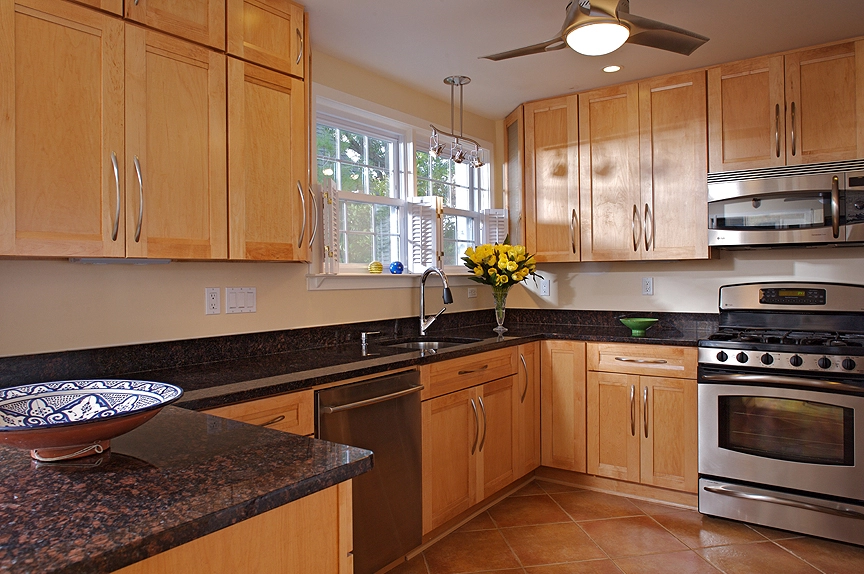
Kitchen with natural maple cabinets, dark granite counters and stainless appliances by Wall to Wall Construction
Solid wood cabinets in good shape are the best candidates for refinishing or refacing.

When refinishing makes sense

Refinishing is the lowest-cost route, and it works well when the only problem is the finish. Good signs include:

  • Solid wood doors and frames. HomeAdvisor notes that staining works best on solid wood, and veneers may call for a different finish.
  • Doors you still like. Paint changes the color, but a flat slab door stays a flat slab door.
  • No water damage or loose joints. HomeAdvisor’s advice is direct: if your cabinets require major repair, consider replacing them instead.

Painted cabinets need careful prep to last. Grease has to come off completely, glossy finishes need to be sanded or primed, and doors are best sprayed off site. A rushed paint job tends to chip at handles and edges within a year or two.

When refacing makes sense

Refacing fits a kitchen where the layout works and the boxes are sound, but the doors look dated. You get new door styles, drawer fronts and hardware, often with soft-close hinges and slides added at the same time, without tearing out countertops in most cases.

HomeAdvisor estimates that a professional crew needs three to five days for a standard kitchen, with another day or two for larger layouts or intricate door styles. That is far less disruption than a full tear-out.

Refacing does have limits. It cannot fix a box with a swollen or rotted bottom, and it does not change where the sink, range or dishwasher sit. If you plan to replace the countertops soon, it is worth asking whether the money is better spent on new cabinets at the same time.

Refacing materials

HomeAdvisor lists rigid thermofoil (RTF) at $80 to $125 per square foot, wood veneer at $100 to $250 and solid wood or plywood at $200 to $500, with laminate as the most budget-friendly choice. Veneer and solid wood can be stained or painted to match. RTF and laminate come in fixed colors and finishes.

When replacing is the better choice

Replacing costs the most and takes the longest, but it is the only option that solves certain problems:

  • The layout does not work. Moving the sink, adding an island, opening a wall or making room for a larger refrigerator all mean new cabinets.
  • The boxes are damaged. Water damage under the sink, sagging shelves, particleboard that has swelled or frames that are out of square.
  • You want more storage. Taller uppers, deeper drawers, pull-out pantry units and corner solutions are much easier with new boxes.
  • You are replacing counters and flooring too. When most of the kitchen is changing anyway, new cabinets usually make more sense than working around old ones.

Cabinet grade drives cost. HomeGuide notes that custom cabinets cost two to three times more than stock or semi-custom options, so semi-custom lines are a common middle ground when a kitchen needs specific sizes.
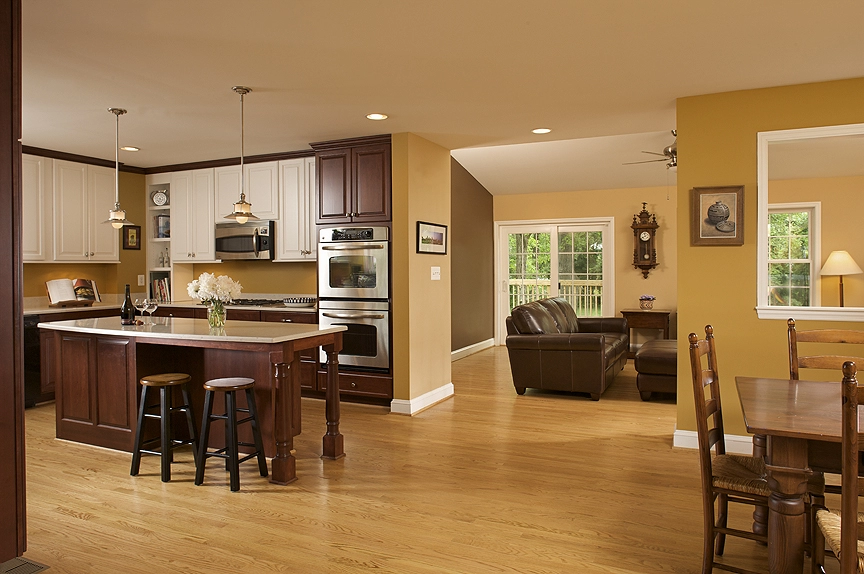
Open kitchen with dark wood cabinets, stainless appliances and an island with seating built by Wall to Wall Construction
A new layout with an island and wall ovens is only possible with new cabinets.

Older Maryland homes: lead paint and layout

Many kitchens in Catonsville, Towson, Ellicott City and the older parts of Baltimore County sit in houses built long before modern kitchen layouts. Two issues come up often.

Lead paint. The EPA notes that homes built before 1978 are more likely to have lead-based paint, and it lists sanding among the common activities that disturb it. If your cabinets or trim have old paint, refinishing is not a casual weekend sanding job. The EPA recommends hiring a lead-safe contractor certified and trained in lead-safe work practices. Our article on EPA lead certification for contractors explains what to ask.

Layout. Older kitchens were often built small and closed off. If your frustration is space and flow rather than color, a new finish will not solve it, and the money may be better put toward a full kitchen remodel.

How to decide: a quick checklist

  1. Open every door and drawer. Look for water stains, swelling, loose joints and sagging shelves. Damaged boxes point to replacement.
  2. Ask whether the layout works. If you like where everything is, refinishing or refacing are on the table.
  3. Decide how much change you want. A new color calls for refinishing. A new door style calls for refacing or replacing.
  4. Look at the rest of the kitchen. If counters, flooring and appliances are also due, price a full remodel before committing to cabinet work alone.
  5. Get a side-by-side quote. A contractor who does full remodels can tell you whether your boxes are worth keeping.

Key takeaways

  • Refinish for a new color on solid cabinets, reface for a new look on sound boxes, replace when the boxes or the layout are the problem.
  • HomeGuide’s 2026 ranges: about $1,500 to $4,500 to refinish, $5,000 to $13,000 to reface and $4,500 to $15,000 to replace with stock or semi-custom cabinets.
  • HomeAdvisor puts refacing at 30% to 50% less than replacing, with a typical three-to-five-day install.
  • In homes built before 1978, sanding painted cabinets calls for lead-safe work practices.

Frequently asked questions

Is it cheaper to reface or replace kitchen cabinets?
Usually refacing is cheaper. HomeAdvisor says refacing is 30% to 50% less expensive than replacing cabinets. The ranges overlap, though: refacing a large kitchen in wood veneer can cost more than stock cabinets in a small kitchen.
What is the difference between refacing and refinishing cabinets?
Refinishing keeps your existing doors and frames and gives them new paint or stain. Refacing replaces the doors, drawer fronts and hardware and covers the frames with new veneer or laminate, so the style of the cabinets changes, not just the color.
How long does cabinet refacing take?
HomeAdvisor estimates three to five days for a standard kitchen, with one to two more days for a larger layout or intricate door styles.
Can damaged cabinets be refaced or refinished?
Not well. Both options keep the existing cabinet boxes, so water damage, swelling or loose joints carry over. When cabinets need major repairs, replacement is usually the better use of the budget.
Do I need a lead-safe contractor to refinish cabinets in an older home?
If the home was built before 1978 and the work involves sanding painted surfaces, the EPA recommends hiring a lead-safe contractor certified and trained in lead-safe work practices, because older homes are more likely to have lead-based paint.

Not sure your cabinets are worth keeping?

Wall to Wall Construction designs and builds kitchen remodels across Maryland, including in Ellicott City, Towson and Fulton. We will look at your kitchen, tell you plainly whether new cabinets are worth it, and give you a clear, itemized estimate.

Wall to Wall Construction, LLC · 11 Newburg Ave, Ste 100, Catonsville, MD 21228 · 410-788-3990 · MHIC #123700
Call Request A Quote